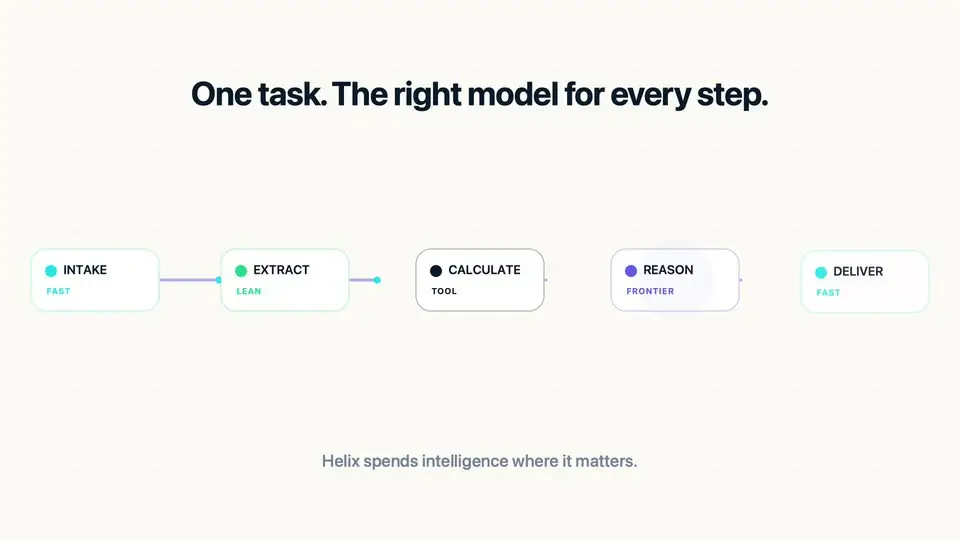
The explosion of AI models has given knowledge workers more choices than ever and more confusion about which one to pick for a given job. Helix AI (https://helixapp.net), a new orchestration platform launching in beta, aims to solve that problem by acting as an intelligent router: it breaks a complex prompt into subtasks, assesses the difficulty of each, and sends only the hardest pieces to expensive frontier models while letting efficient models handle the rest.
“Access to models is everywhere,” the company says. “The edge is knowing which intelligence to use, when to use it, and when not to spend more.” Helix’s tagline “One adaptive intelligence for every kind of work” captures its ambition to become a single interface that hides the complexity of model selection.
Helix was founded by a team that previously built enterprise automation tools. The platform is currently in a waitlist phase, with beta access opening soon. Users can sign up at helixapp.net.
How Helix works
At the core of Helix is what the company calls the Neural Edge, a system that deconstructs a user’s prompt into discrete tasks. For example, a request to “write a marketing email based on these three customer testimonials and then translate it into Spanish” contains both creative writing and translation. Helix’s routing engine evaluates each sub task for complexity. Translation, which a smaller model can handle accurately, gets sent to a low cost model. The creative writing which may require nuance, tone, and brand voice gets routed to a frontier model like GPT 5.6 or Claude Fable 5.
“A complex prompt is rarely complex everywhere,” the company explains. “Helix Neural Edge breaks it into distinct tasks, understands the difficulty of each one, and sends only the work that needs deeper reasoning to a frontier model. Efficient models handle the rest before Helix brings everything back into one coherent answer.”
This approach is designed to reduce cost and latency without sacrificing quality. In many current workflows, users either default to a powerful model for every task paying a premium for simple work or they manually switch between models, which is time consuming and error prone.
Three design principles
Helix’s routing logic is built on three principles. First, capability first: the system eliminates routes that cannot satisfy the task before it considers price. This ensures that quality is never compromised for cost savings. Second, sparse by default: the lowest cost route that can succeed runs first. There is no expensive model voting or consensus mechanism by default. Third, a learning loop: every validated outcome whether a successful email or a failed code snippet sharpens future routing decisions across quality, cost, and latency.
“Every kind of work. One adaptive intelligence. Sense. Route. Resolve,” the company says, summarizing its philosophy.
Context and significance
The AI model landscape has become increasingly fragmented. OpenAI, Anthropic, Google, Meta, and a host of startups offer dozens of models with varying strengths, pricing, and latency profiles. For individuals and small teams, keeping up is impractical. Helix joins a growing category of “model routers” or “orchestration layers” that aim to abstract away the choice. Competitors include platforms like Portkey, OpenRouter, and others, but Helix differentiates itself with its Neural Edge decomposition and its learning loop.
For the typical knowledge worker a marketer, a developer, a researcher Helix promises a single text box where they can type any request and trust that the system will use the most efficient model for each part of the job. The practical benefit is lower costs (fewer calls to expensive models) and faster responses (smaller models return results in milliseconds).
Looking ahead
Helix is currently accepting sign ups for its waitlist. The beta will open soon, and the company plans to release pricing and performance benchmarks alongside the launch. Early adopters will include freelancers, startup teams, and enterprise users who want to reduce their AI spend without cutting corners on output quality.
“Only the hard parts go frontier,” the company says. For anyone who has ever watched a simple grammar check burn through a premium API credit, that promise is worth a test drive.